Every article I’ve read about decluttering makes it sound so easy: figure out what sparks joy, toss the rest, and enjoy your tidy home. If only it worked like that.
Whenever I try to clear out my space, I run into the same problem. It’s not that I can’t let go of things. The real issue is, I have no idea what to do with them next. Should I sell them? Donate them? Recycle them? And where do I even take them? I feel so guilty about sending good stuff to the landfill that I end up moving things from one room to another, never actually getting rid of anything.
Things finally started to make sense when I stopped focusing on throwing things away and started looking for ways to avoid sending my unwanted items to landfill—for example, this list of ways to get rid of clothes that can’t be sold.
But before you can do any of that, you have to sort your stuff first. That’s where a lot of us get stuck.


Why decluttering feels so emotionally hard
Decluttering isn’t just about moving stuff around. It’s emotional and mental, too. Every object is a tiny decision, a reminder of money spent and memories made. All those little feelings add up, which is probably why so many of us feel overwhelmed.
Barbara Hemphill, founder of the Productive Environment Institute, famously said, “Clutter is nothing more than postponed decisions.” She later explained that we often minimise how hard those decisions are.
“Usually, words such as ‘just,’ ‘only,’ or ‘merely’ are added, making it seem as though making a decision is no big deal,” she writes. “In my 40+ years in the organising and productivity industry, I have observed that making a decision is a big deal — and it makes the difference between a life of regret and a life well-lived.”
For people with ADHD or decision fatigue, this process can be especially challenging. One Reddit user put it perfectly: “Decluttering takes a lot of executive function, and people with ADHD have a hard time with that.”
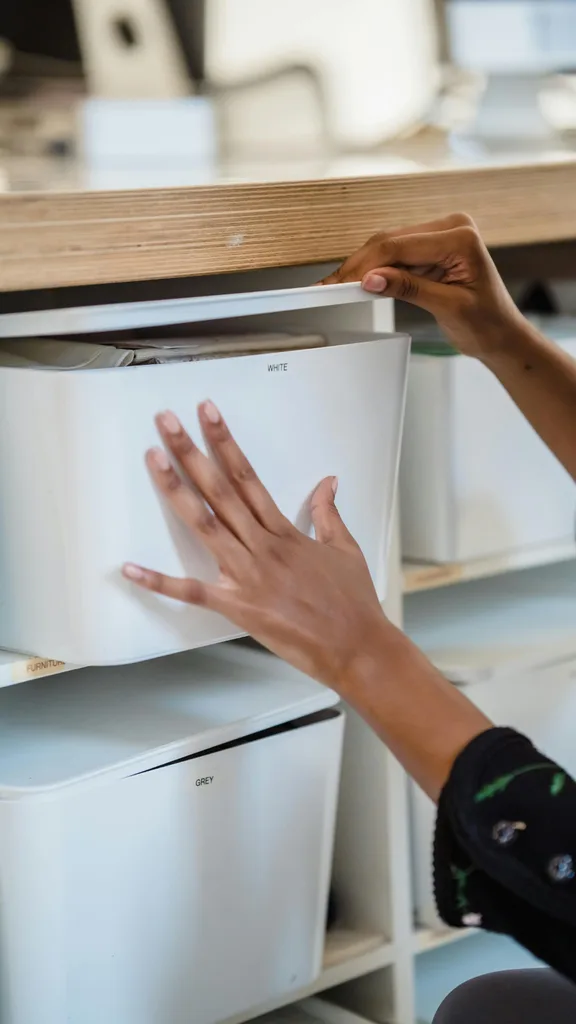
What ADHD clutter looks like
ADHD clutter isn’t always messier. It’s more about the mental load. You’ll see piles of ‘to deal with later’ stuff: unopened mail, half-finished projects, or bags waiting to go to donation bins. Each one is just another decision waiting to be made. Breaking decluttering into bite-sized, low-stakes tasks helps. That’s where systems like the 3-Basket Method come in.
The 3-basket system
All you need is a rubbish bag and three washing baskets, or whatever you have lying around that works.
- Rubbish bag: Obvious rubbish goes straight in.
- Basket 1: Doesn’t belong here. These are things that have a home somewhere else.
- Basket 2: Doesn’t belong anywhere. These are things that don’t really have a proper place.
- Basket 3: Want to throw away, but can’t. These are the emotional maybes.
The first two baskets are pretty straightforward, but the real progress happens with the last two.
For the ‘doesn’t belong anywhere’ pile, decide whether to give the item a proper home or let it go. For the sentimental ‘can’t throw away’ things, try boxing them up for six months. If you don’t miss them, it’s probably safe to donate. And if something still means a lot to you, it’s okay to keep it. Decluttering doesn’t have to mean letting go of what makes you happy.
The emotional payoff of letting go
Studies show that clutter can increase cortisol levels, especially in women. So, what is the easiest way to reduce clutter in your home and keep it that way?
Decluttering rules that actually work
To help you out, here are some decluttering rules that have helped others. Although they still require some decision-making, having a system can help you feel less overwhelmed.
Core 4 method
Kayleen Kelly is a professional organiser who specialises in chronic clutter and clients with ADHD. To help make life easier for her clients, she came up with the CORE 4 method, which breaks down the task of decluttering into 4 easy steps:
- Clear out
- Categorise
- Cut out
- Contain
The 80/20 rule
It’s said we use about 20% of our things 80% of the time. That’s a lot of stuff taking up space in your home. Try to figure out which 20% you actually use, and find a new home for the rest.
The 5-year rule
If you haven’t used, worn, or even thought about something in the last five years, it’s time to say goodbye. Of course, that doesn’t apply to items with sentimental value.
The OHIO method
The OHIO method stands for Only Handle It Once. This means when you pick up something while cleaning or tidying your home, it does not go on the bench for you to put away later. Instead, you must decide on the spot where it goes. Otherwise, you are just moving clutter from one part of the house to another.

Related stories

Native ad body.
Native ad body.



Native ad body.